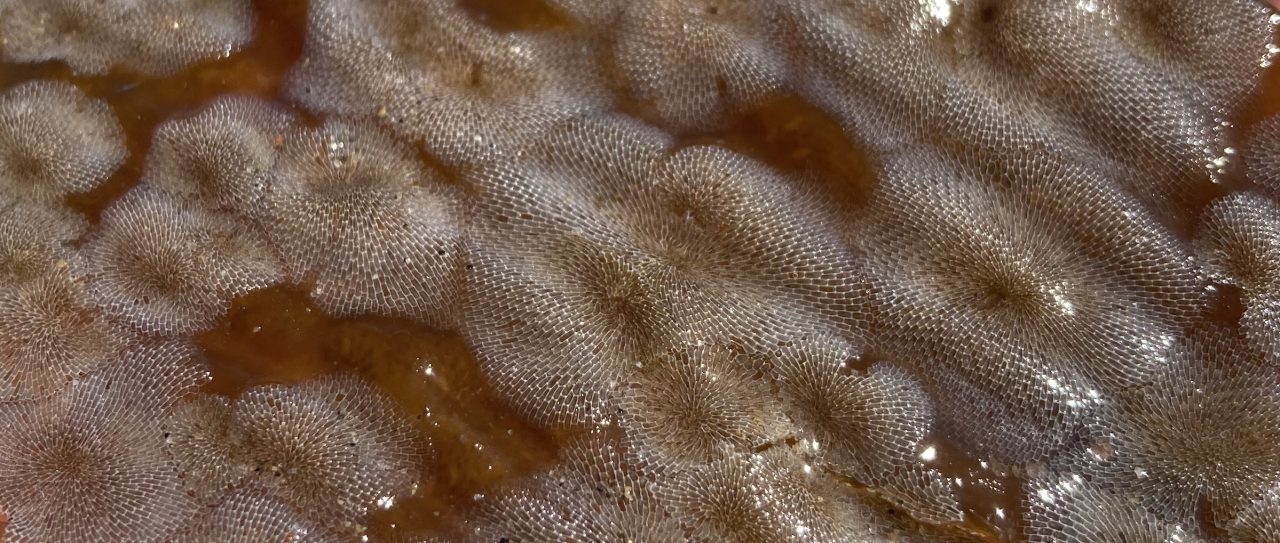
I think it’s prudent to start off this blog by addressing the question most people ask me directly after asking me “what’s your favorite animal?”
So…what is a bryozoan?
Bryozoans get their name from two root words, “bryo” and “zoa”. “Bryo” refers to moss–bryophytes are mosses and relatives! “Zoa” refers to animals, so bryozoans are officially called “moss animals.” This is rather accurate, all things considered, as bryozoans often look like mosses and are indeed animals.
(Perhaps it is more prudent to refer to mosses as “moss plants,” given their word root origins?)
Beyond that, bryozoan taxonomy has a varied history and is the subject of another post. But suffice it to say that bryozoans are now generally grouped within Phylum Bryozoa. Phylum Bryozoa is the newest phylum to come about in evolutionary time!
Each bryozoan group is actually a colony! Much like corals, bryozoan colonies are made up of many individuals which share resources. However, they are absolutely not corals!
Bryozoan individuals are called zooids and each feeding zooid has a ring of ciliated tentacles–cilia are like little hairs (although they are not hairs at all). A ring of ciliated tentacles is called a lophophore!
Bryozoan zooids have the capacity to specialize into different zooid types that carry out different functions! Not all zooids have lophophores.
Bryozoans show a variety of growth forms, depending on the species: encrusting, upright, gelatinous mounds…
Bryozoans can live in marine, fresh, and brackish water, depending on the species!
Still want more bryozoan information? Good! I’ll be posting information about interesting species, bryozoan anatomy, taxonomy, and more on this blog!
—
Source: Invertebrate Zoology by Ruppert, Fox, & Barnes
 Bryozoan-based Blogging