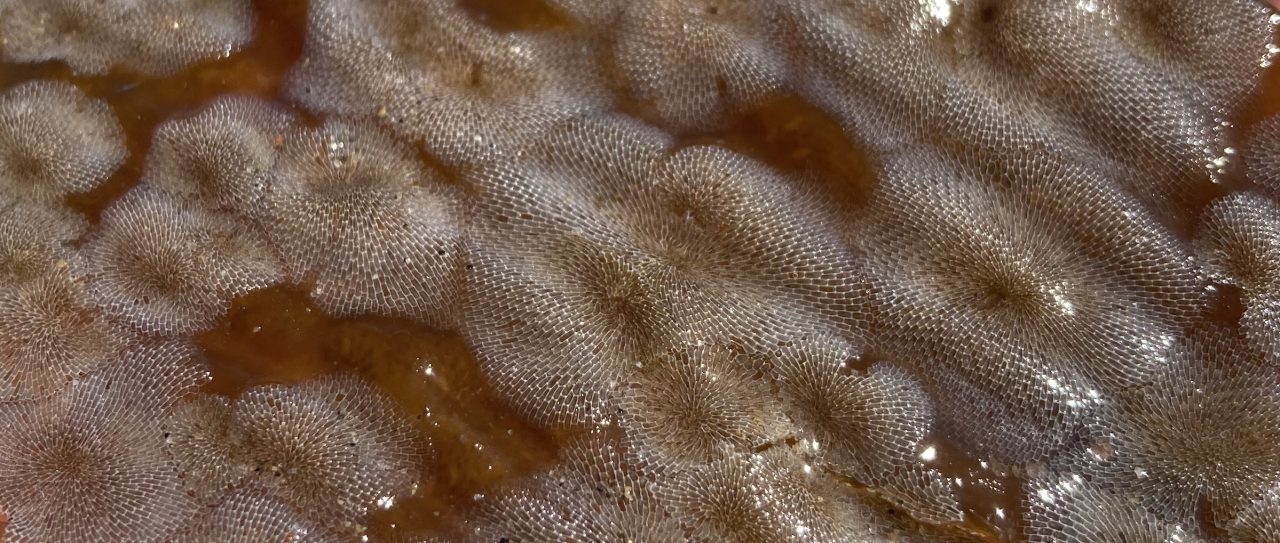
There are many terms used to refer to bryozoan morphology, some of which can be found here!
Cystid
The external protective layer (zooecium) and the body wall (epidermis, basement membrane, muscles, mesothelium). (Ruppert, Fox, & Barnes, 2004)
Funiculus
Tissue linking two bryozoan zooids together–mesothelial tissue. (Ruppert, Fox, & Barnes, 2004)
Lophophore
A lophophore is a ring of ciliated tentacles (wherein the tentacles have small hair-like extensions known as cilia), which ae typically used for feeding. (Ruppert, Fox, & Barnes, 2004)
Polypide
The polypide includes everything besides the external covering and associated tissue–lophophore, introvert, digestive system, gonads, funiculus, muscles, and splanchnic mesothelium. (Ruppert, Fox, & Barnes, 2004)
Zooecium
The external, protective covering of a bryozoan zooid. May be made of calcium carbonate, chitin, carbohydrate, or protein. Might also be called the cuticle, exoskeleton, or ectocyst. (Ruppert, Fox, & Barnes, 2004)
Zooid
An individual bryozoan. See types below–all besides the autozooids are not present in all bryozoan species…
Autozooid
Most common zooid type; feeding zooid. (Ruppert, Fox, & Barnes, 2004)
Avicularium
Modified zooid that possesses an operculum that can shut like a jaw–name means “little bid beak”. (Ruppert, Fox, & Barnes, 2004)
Kenozooid
A zooid that is mostly body wall and some tissue. They often serve some sort of defensive or attachment purpose. (Ruppert, Fox, & Barnes, 2004)
Vibraculum
A zooid where the operculum is modified into a long seta, which resembles a jousting pole. It can move in a sweeping motion, and may be utilized for colony maintenance or for movement in some bryozoan species. (Ruppert, Fox, & Barnes, 2004)
Ovicells
Zooids modified for holding the developing embryo. (Ruppert, Fox, & Barnes, 2004)
 Bryozoan-based Blogging