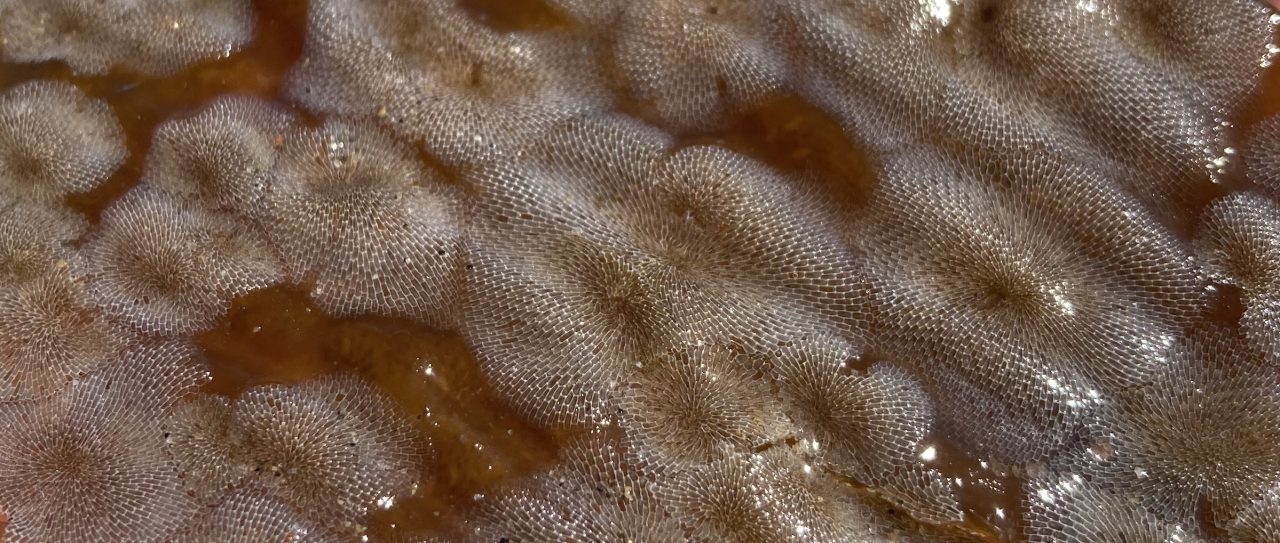
Perhaps the more important question is: “Wait, which ones are bryozoans again?”
Entoproct and ectoproct are separated by just one letter–and the similar terms reflect how similar they look to one another!
Here are some example images of entoprocts (also known as kamptozoans): https://commons.wikimedia.org/wiki/Category:Barentsia
Kampto- refers to the Greek word for bending, as they often bend back and forth on their stalks!
Ectoprocts are our bryozoans! Scientists now tend to refer to ectoprocts as bryozoans, although the term ectoproct still floats around in some circles. You can see how entoprocts do look rather similar to the bryozoans. Like bryozoans, brachiopods, and phoronids, entoprocts have a ring of ciliated tentacles, which captures food. Some will consider the entoprocts’ ciliated tentacles to be a lophophore (as in the lophophorates: bryozoans, brachiopods, and phoronids), and others won’t.
There are definite differences between ectoprocts and endoprocts both etymologically and anatomically, though…
The shared root word “-proct” refers to the anus of the organisms. “Ento” means “within” and “ecto” means “outside”. This refers to the location of the anus in both groups–in entoprocts, the anus is within the ring of ciliated tentacles (lophophore), and in ectoprocts, the anus is outside the lophophore.
There are other differences too–
Ectoprocts/bryozoans have a true body cavity, known as a coelom. On the other hand, entoprocts do not have a true coelom at any point during their development.
Entoprocts have solid tentacles, whereas bryozoan tentacles are hollow. The cilia on the tentacles creates a current that allows for more efficient feeding–in entoprocts, the current runs from the base to the tip of the tentacles, whereas the current runs from the tip to the base of the tentacles in bryozoans.
Genetically, entoprocts and ectoprocts don’t seem to be very related….or maybe they are! A recent paper, “Polyzoa is back: The effect of complete gene sets on the placement of Ectoprocta and Entoprocta“, suggests that we may want to combine Ectoprocts and Entoprocts back into the Polyzoa group. Guess what? The Bryozoa/Ectoprocta are ALSO known as the Polyzoa on their own! We have had a lot of different names for these organisms…
Where will the ectoprocts & entoprocts end up taxonomically? That remains to be seen as more research is done! But, for now, we are working with Phylum Bryozoa and Phylum Entoprocta!
Source/for further reading: Invertebrate Zoology by Ruppert, Fox, & Barnes
 Bryozoan-based Blogging